
Baby's 6-Month Checkup and Vaccines: What to Expect
The 6-month well-child visit finishes your baby's first series of infant vaccines and is often the first chance to protect them against the flu. Your pediatrician will also check growth and development and talk with you about starting solid foods, teething and safety as your baby becomes more mobile. Most side effects from the 6-month shots are mild and pass within a day or two. Here is what happens at the appointment, which vaccines are usually given, and when to call your pediatrician afterward.
What Happens at the 6-Month Well-Child Visit?
Your baby will be weighed and measured for length and head circumference, and the numbers are added to their growth chart. The physical exam covers the heart, lungs, eyes, ears, hips, skin and mouth, including any new teeth. Your pediatrician will also ask about feeding, sleep, development and your home, which can include questions about lead exposure, since babies start putting everything in their mouths around this age.
Which Vaccines Does a Baby Get at 6 Months?
Under the American Academy of Pediatrics (AAP) 2026 immunization schedule, the 6-month visit usually includes:
- DTaP (third dose), protecting against diphtheria, tetanus and whooping cough
- Pneumococcal conjugate vaccine (PCV) (third dose)
- Hib (third dose), depending on the brand your pediatrician uses
- Rotavirus (third dose), only for babies on the three-dose brand
- Hepatitis B and polio (IPV) third doses, which can be given any time from 6 to 18 months
- Influenza, during flu season
- COVID-19, which the AAP recommends for children 6 to 23 months
Combination vaccines often cover several of these in one injection, so your baby may get fewer shots than this list suggests. Federal recommendations for some childhood vaccines changed in 2026 and differ from the AAP schedule in places, so your pediatrician will explain what is recommended for your baby. For every age, see our children's vaccine schedule by age.
Why Some 6-Month Doses Depend on the Brand
Rotavirus vaccine, given as drops by mouth, comes as a two-dose series that ends at 4 months or a three-dose series with a final dose at 6 months, and every dose must be finished by 8 months of age. Hib vaccine also has a brand that needs only two infant doses. Your pediatrician's office tracks which brands your baby received, so you do not need to remember.
Your Baby's First Flu Shot: Why Two Doses?
Six months is the youngest age a baby can get a flu vaccine. Children from 6 months through 8 years who are getting the flu vaccine for the first time need two doses, given at least four weeks apart, to build full protection. If your baby gets the first dose at the 6-month visit, plan a quick follow-up for the second dose about a month later. Our guide to flu shots for kids covers timing and the two-dose rule in more detail.
RSV Protection Heading Into Winter
RSV season usually runs from fall through spring. If your baby has not had an RSV antibody shot, and you did not get the RSV vaccine during pregnancy at least two weeks before birth, the AAP recommends one dose of an RSV antibody for babies younger than 8 months who are entering their first RSV season. If you are not sure whether your baby is protected, ask at this visit.
Common Side Effects and How to Comfort Your Baby
Many parents find their baby reacts much like they did after the 4-month shots. In the first day or two, your baby may:
- be fussier or sleepier than usual
- have redness, swelling or tenderness where a shot was given
- run a low-grade fever
- eat a little less for a feed or two
Extra feeds, cuddles and a calm day go a long way, and a cool, damp cloth can soothe a sore leg. At 6 months, both acetaminophen and ibuprofen can be used for fever or discomfort, but the dose is based on weight, so check with your pediatrician or pharmacist before giving either. Giving medicine before the shots to prevent a reaction is not recommended.
When to Call the Pediatrician After 6-Month Shots
Call your pediatrician if your baby:
- has a temperature of 104°F (40°C) or higher, or a fever lasting more than 48 hours after the vaccines
- cries inconsolably for 3 hours or more
- refuses several feeds in a row or has noticeably fewer wet diapers
- has a sore spot that keeps getting redder or more swollen after two days
- has repeated vomiting, blood in the stool, or episodes of intense belly pain with drawing up of the legs, which can rarely follow a rotavirus dose
Call 911 or go to the nearest emergency room for trouble breathing, swelling of the face, lips or tongue, widespread hives, a seizure, or a baby who is limp or very hard to wake.
Milestones Around 6 Months
By about 6 months, many babies:
- laugh and recognize familiar people
- take turns making sounds with you, squeal and blow raspberries
- roll from tummy to back
- push up on straight arms during tummy time
- lean on their hands for support when sitting
- reach for toys and bring things to their mouth to explore them
Mention it at the visit if your baby does not reach for things, does not respond to sounds, seems very stiff or very floppy, or has lost skills. Our guide to child development milestones by age shows what comes next.
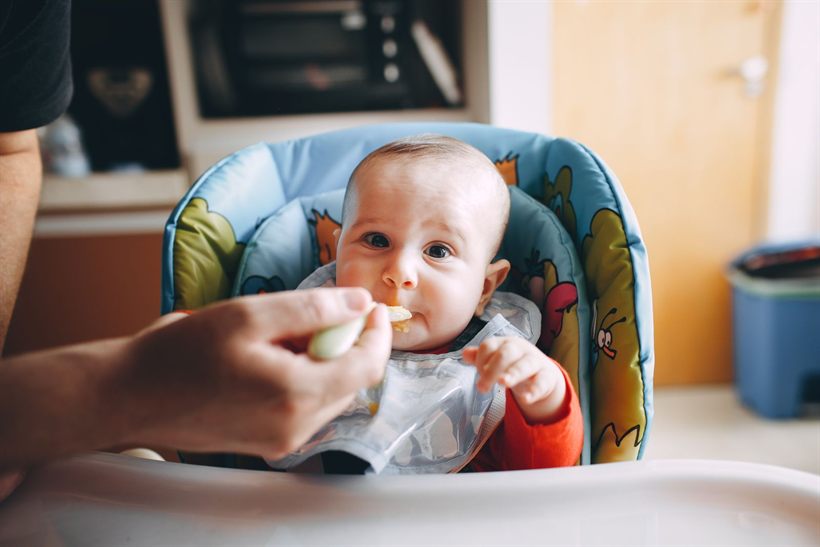
Starting Solid Foods at 6 Months
The AAP recommends starting solid foods at about 6 months, alongside breast milk or formula. Signs your baby is ready include sitting up with little support, good head control, opening their mouth when food comes near, and moving food to the back of the mouth to swallow. A few practical tips:
- Start with iron-rich foods, such as iron-fortified infant cereal or pureed meat.
- Offer one new single-ingredient food at a time and let your baby set the pace.
- Common allergy foods, including smooth thinned peanut butter and well-cooked egg, can usually be introduced early rather than delayed. If your baby has severe eczema or a known food allergy, talk with your pediatrician first.
- Small sips of water from an open or straw cup are fine once solids start. Skip juice, and wait until 12 months for honey and for cow's milk as a drink.
- Avoid choking hazards such as whole nuts, whole grapes, popcorn and hard raw vegetables.
Teething, Sleep and Safety
Many babies get their first tooth between 4 and 7 months, and some not until after their first birthday. Once a tooth appears, brush twice a day with a rice-grain smear of fluoride toothpaste. For sore gums, try a clean chilled teething ring. Teething gels with benzocaine and amber teething necklaces are not safe for babies.
Keep placing your baby on their back to sleep on a firm, flat surface with no pillows, bumpers or loose blankets. If your baby rolls over on their own during sleep, you do not need to turn them back. With crawling on the way, babyproof now: secure heavy furniture, cover outlets, gate stairs and skip baby walkers, which the AAP advises against. Keep your baby rear-facing in the car seat until they reach its height or weight limit.
Frequently Asked Questions
What vaccines does my baby get at 6 months?
Under the AAP 2026 schedule, usually third doses of DTaP and pneumococcal vaccine, often Hib and rotavirus depending on the brand, and hepatitis B and polio doses due between 6 and 18 months. The AAP also recommends flu and COVID-19 vaccines from 6 months.
Can my 6-month-old get the flu shot?
Yes. Six months is the youngest age for the flu vaccine, and babies getting it for the first time need two doses at least four weeks apart.
Are 6-month vaccine side effects worse than earlier ones?
Usually not. Most babies have the same mild fussiness, sleepiness or sore leg they had at 2 and 4 months, and these settle within a day or two.
Can I give my baby ibuprofen after the 6-month shots?
Yes, from 6 months ibuprofen or acetaminophen can be used. Ask your pediatrician or pharmacist for the right dose for your baby's weight.
Should my baby start solid foods at 6 months?
The AAP recommends starting solids at about 6 months, once your baby shows signs of readiness. Breast milk or formula stays the main source of nutrition until the first birthday.
Talk to Your Pediatrician
Six months brings a lot of firsts, and you do not have to sort through them alone. As a pediatrician in Christiansburg, VA, our team is here for your baby's checkups, vaccines and everyday questions. Request an appointment when your baby is due for their visit. This article is for general education and does not replace medical advice for your baby's individual needs.
Medically Reviewed By

Dr. Rahul Pandey is a board-certified pediatrician with fellowship training in pediatric critical care. He completed his pediatrics residency at New York Medical College and a critical care fellowship at the University of Florida, and serves as an Associate Professor at both Edward Via College of Osteopathic Medicine and Virginia Tech Carilion School of Medicine.